Jules
Bird BoxJules is a resident of the Shillingham house community whose practical steadiness and attachment to Victor shape the group’s efforts to survive. He welcomes Malorie into the house, helps care for its animals, and joins Tom in dangerous searches beyond its covered windows. His work is often collaborative and methodical, but the limits of such control become clear when the animals the house relies on begin to behave unpredictably.
Identity and Place in the House
When Malorie arrives, Jules introduces himself as someone who has lived at the house for two months. He says that most of the residents have been there about as long, while Tom and Don arrived earlier. The house has one woman and four men among its residents, and Jules is one of the people who helps Malorie make sense of this unfamiliar community.
His first welcome is practical: he offers to take Malorie’s suitcase. He appears kind, with short, dark hair that looks as though he has been working outside. In a home where newcomers must enter with their eyes closed and trust strangers to guide them, these ordinary gestures help make the house feel like a place of shared labor rather than simply a sealed refuge.
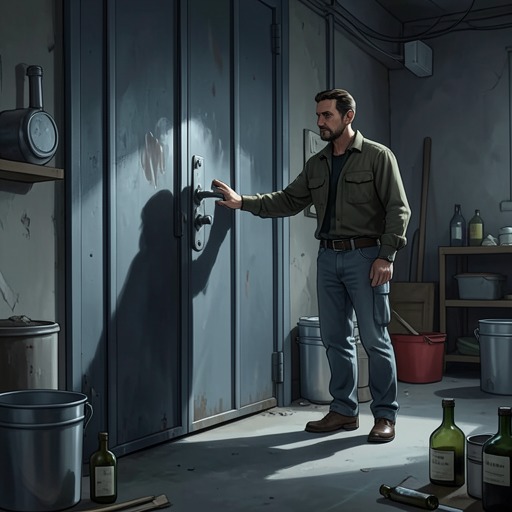
Jules’s attention to the house’s layout is shaped by its vulnerabilities. In a discussion about where the residents could retreat if a creature entered, he points out that the cellar door’s lock is old and delicate, while the bolt on the attic door is exceptionally strong. He therefore considers the attic the safer place to secure themselves. His assessment turns a seemingly domestic difference between two doors into a question of collective survival: the house offers protection, but only if its occupants understand which parts of it can be defended.
Victor and Care for Animals
Jules’s closest stated bond in the evidence is with Victor, a six-year-old border collie he has had since the dog was a puppy. Victor approaches Malorie curiously and waits at her feet to be petted. For Malorie, the dog also recalls Shannon, whom she thinks would have liked him. The encounter connects Jules’s long-standing companionship with Victor to Malorie’s memories of someone lost, even as Victor becomes part of the practical life of the household.
The residents’ animal care is carefully structured. During an outdoor task at the well, Jules waits blindfolded by the stake while another housemate works along a path marked with pieces of old picture frames. A rope attached to the worker provides a safeguard, while Cheryl listens from the kitchen as the designated backup in case something goes wrong. This arrangement places Jules within a shared safety procedure: outdoor work is not solitary, even when the person carrying it out must rely on touch, hearing, and a guide rope.
When Tom proposes a search for dogs, Jules offers to go with him. He says that if he will not let Tom use his own dog, he can at least help round up other dogs. Don objects that the plan is reckless, but Jules’s offer shows the difference between protecting a valued companion and refusing to help altogether. His willingness to take part does not erase the danger; it makes care for Victor part of a broader effort to secure help and resources for the house.
Searches with Tom
Jules and Tom’s work beyond the house proceeds through close attention to sound, movement, and route. In one search, they find a boy’s parents lying in the basement, dressed as though for church, with a handwritten note on the mother’s chest. Nearby, they discover a husky sheltering among fur coats. The dog is severely underfed, and Tom suspects it has been eating from the dead parents. Jules takes meat from his duffel bag, tears off a piece, and tosses it to the animal. The husky first emerges cautiously and then eats eagerly. When Tom asks whether it is friendly, Jules answers that a dog will quickly befriend people who feed it.
The moment shows Jules’s practical understanding of animals without making trust instantaneous or guaranteed. Feeding the husky is an immediate act of care, but it is also a way to establish the first terms of cooperation with a frightened animal. The pair’s search has brought them into contact with death and neglect; Jules responds by attending to the living creature they have found.
On another outing, Victor’s interest in a freestanding garage leads the men to investigate it. The side door is locked, and the only window is covered from inside with cardboard. Jules breaks the window and offers to enter through the narrow opening; Tom insists on going too. They tie Victor to a gutter and climb inside together, where something growls at them. The scene makes their method and its limit visible at once: they investigate by testing an obscured space, but neither the dog nor their preparations can make an unknown threat safe.
Jules also joins Tom in a planned journey to obtain medical supplies. The route is described as the only place where the supplies can be confidently obtained, and the need includes bandages, ointment, aspirin, and other basic medical materials. The group prepares the trip by mapping it in detail: Tom and Jules are to follow the rhythm of a single song, “Halfway to Paradise,” played repeatedly on a radio, using counted steps for each direction and portion of the route. Gary jokes that they will be dancing; Tom corrects him, making clear that the rhythm is a navigation aid for walking to get help. Jules’s role belongs to a larger communal attempt to turn sound and measurement into a substitute for sight.
Loyalty, Risk, and the Limits of Protection
Jules’s bond with Victor acquires a darker significance when Malorie later encounters the dog in distress. The growl coming from Victor is unlike any she has heard from him or from another dog. She apologizes to him for bringing him there, while he moves violently enough that the wooden post holding him splinters. Malorie understands Victor as her last link to the housemates. Through this episode, Jules’s relationship with the dog reaches beyond his individual attachment: Victor carries the memory of the community into Malorie’s later struggle, and the dog’s altered behavior threatens that connection.
The contrast between the dog as companion and the dog as a source of danger complicates the community’s attempts to depend on animals. Tom’s proposal for an expedition includes helmets to protect blindfolds, butcher knives, and dogs that could lead the searchers; if a dog went mad or attacked, the plan was to release the leash and defend themselves. Jules’s care for Victor and his readiness to help find other dogs exist beside that contingency. The animal is at once a companion, a potential guide, and a risk that cannot be controlled by affection alone.
Jules’s importance is therefore conveyed less through solitary heroics than through repeated participation in shared work. He welcomes newcomers, waits as part of a safety arrangement, joins Tom’s searches, feeds an abandoned dog, and accepts a role in a route that depends on careful counting and sound. The plans offer discipline against uncertainty, but their success is never assured. When Tom, Jules, and Victor later go down to the basement together, Malorie follows and discovers Don standing in the shadows. The brief return to the house places Jules once more among companions, but the house’s concealed spaces and the group’s mounting dangers remain unresolved.